
NEWS & BLOGS
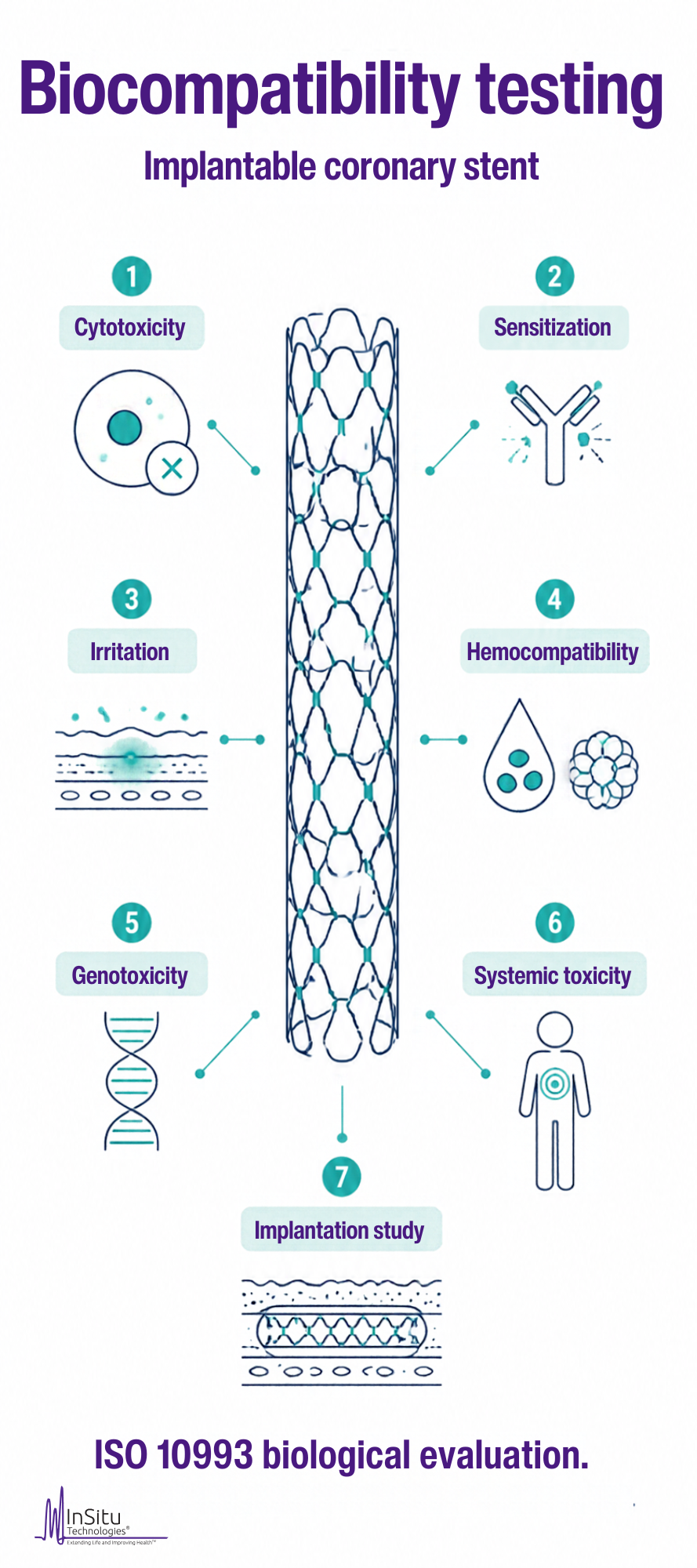
Biocompatibility testing infographic for an implantable coronary stent
Biocompatibility Testing: The Invisible Safety Layer Behind Every Stent
Before a coronary stent ever reaches a cath lab, it has to pass one of the most rigorous testing regimes in medical device development: biocompatibility testing under ISO 10993, the international standard governing the biological evaluation of medical devices.
A coronary stent is classified as a permanent, blood-contacting implant. That classification alone triggers a demanding evaluation panel, because the device isn't just expected to work mechanically. It has to coexist safely with living tissue and circulating blood for the rest of a patient's life.
The seven-part evaluation
- Cytotoxicity — Does the material damage or kill cells on contact?
- Sensitization — Could the material trigger an allergic or immune hypersensitivity reaction?
- Irritation — Does the device cause local tissue inflammation?
- Hemocompatibility — Does it activate clotting, damage red blood cells, or trigger complement activation?
- Genotoxicity — Could the material or its degradation products cause DNA damage?
- Systemic toxicity — Could the device cause harm beyond the implant site?
- Implantation study — How does surrounding tissue respond over extended implantation periods?
Why this matters beyond the checklist
Every material is evaluated, not just the finished assembly: the metal platform, any polymer coating, the therapeutic drug in a drug-eluting stent, and even manufacturing residues left behind after processing.
This is where quality systems and design verification intersect most directly with patient safety. A change as small as a new adhesive or coating supplier can trigger a re-evaluation of the biocompatibility file.
It's unglamorous work. It's also the reason a device this small can safely sit inside an artery for a patient's lifetime.